„Dimitrie Cupovski“ 13, 1000 Skopje +38923244000 ic@mchamber.mk
„Dimitrie Cupovski“ 13, 1000 Skopje +38923244000 ic@mchamber.mk
.jpg)
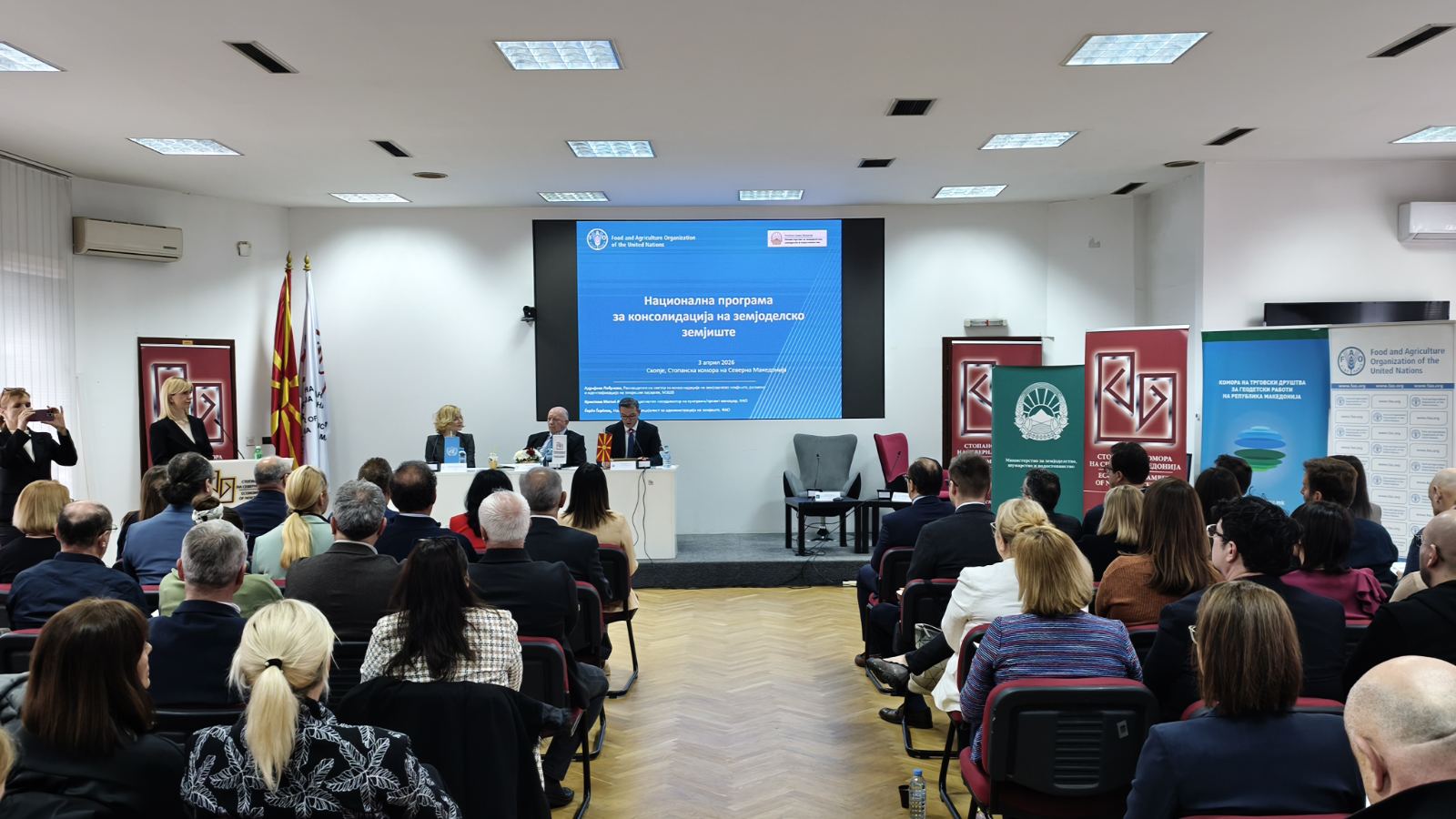
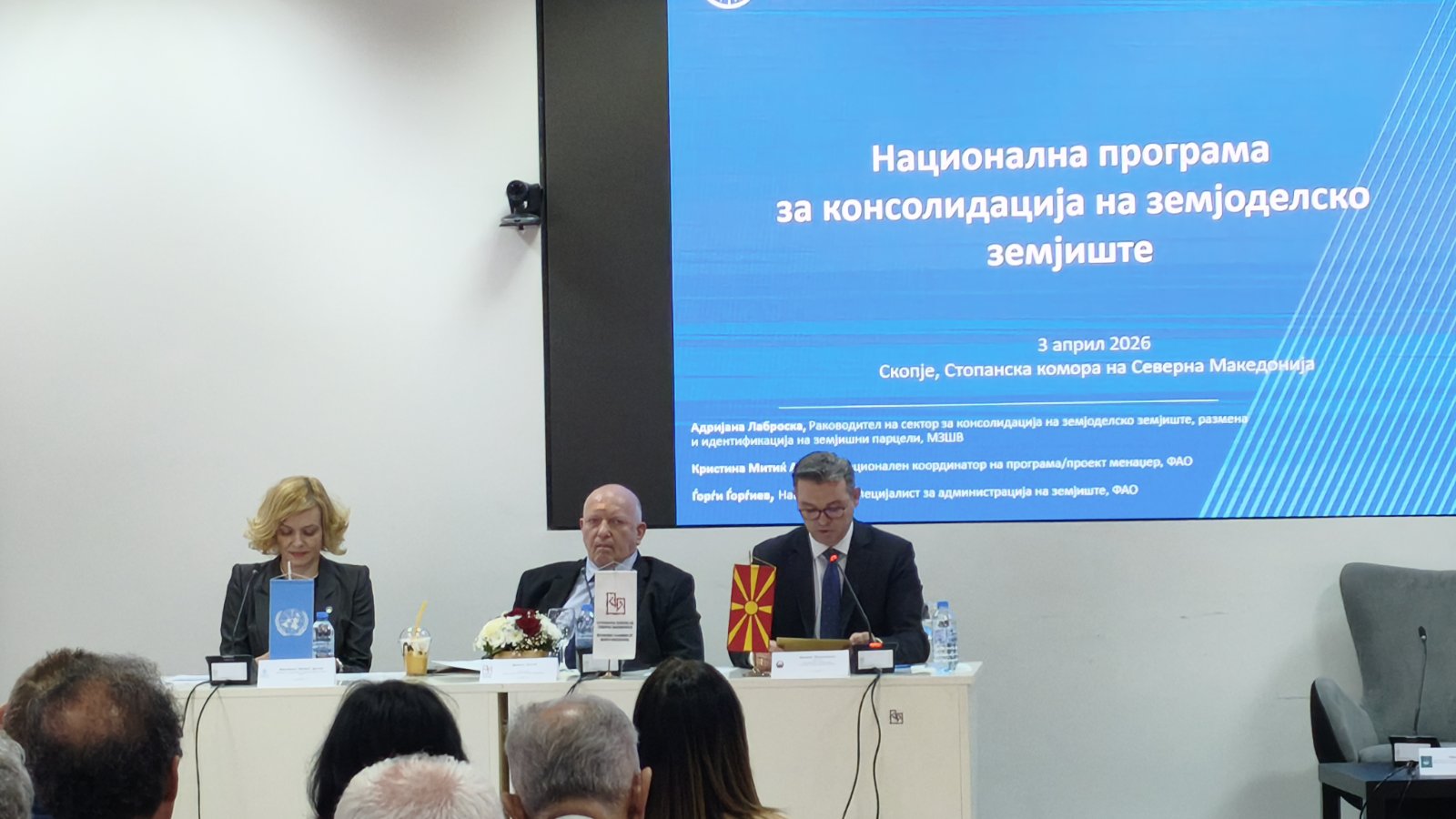
An event dedicated to the consolidation of agricultural land as one of the key priorities for developing modern and competitive agriculture was held, organized by the Economic Chamber of North Macedonia in cooperation with the Ministry of Agriculture, Forestry and Water Economy and the Food and Agriculture Organization of the United Nations (FAO).
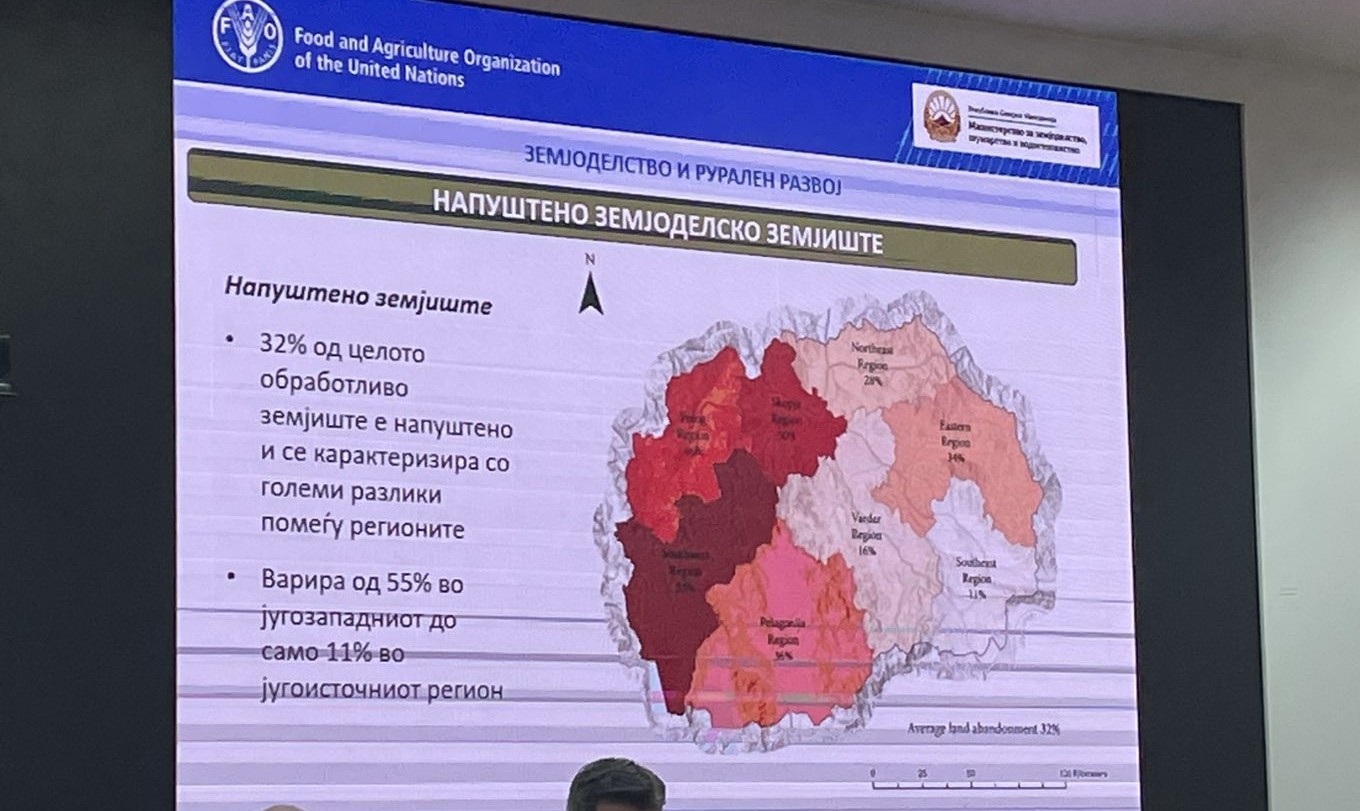
It was highlighted at the event that as much as 32% of the country’s agricultural land is abandoned, further underscoring the need for urgent and systemic measures to improve resource utilization and strengthen productivity.
The event was opened with welcome remarks by the Minister of Agriculture, Forestry and Water Economy, Cvetan Tripunovski; the President of the Economic Chamber of North Macedonia, Branko Azeski; and Morten Hartvigsen from the FAO Regional Office for Europe and Central Asia, who addressed participants via video message. Kristina Mitikj-Arsova, National Project Coordinator within FAO, also addressed the audience.
The President of the Economic Chamber, Branko Azeski, called for more vigorous and decisive action in implementing the land consolidation strategy, stressing that there must be no delays or excuses.
“The question is how to implement the fundamental values in order to make this country a functioning state – that means, on a political level, the rule of law; on an economic level, the functioning of market principles; and in agriculture, land consolidation. How do we implement them? We will set them as priorities and support them with individuals who will stand behind them. What are we doing instead? We keep giving justifications and looking for excuses. We cannot adopt the land consolidation strategy because of the war in Iran, we cannot adopt it because of the military conflict in Ukraine, we cannot adopt it because of elections. Just excuses and more excuses, while the essence is to roll up our sleeves and implement what knowledgeable people already know and what is already written. Now we have concrete activities moving in the direction of addressing implementation, such as the construction of the motorway to Ohrid, as well as other infrastructure projects, in order to integrate into the EU family,” Azeski emphasized.
He added that it is necessary to unite all stakeholders, pointing out that the joint approach of the chambers of commerce is a positive example of how processes can be accelerated and economic results and a higher standard of living achieved.
The Minister of Agriculture, Forestry and Water Economy, Cvetan Tripunovski, emphasized that land consolidation is a proven instrument for overcoming structural challenges in agriculture. “Experience to date shows tangible benefits – consolidated plots, more efficient land use, reduced costs, and increased readiness for investment. With the National Land Consolidation Strategy 2025–2035, we are positioning consolidation as a key instrument for modernization and strengthening the sector’s resilience,” Tripunovski stated.
In his video address, Morten Hartvigsen from FAO noted that land consolidation has been successfully applied in Europe for decades as a tool for improving the structure of agricultural holdings. “North Macedonia has established a solid foundation, and the next step is to link the process with investments in modern agricultural infrastructure,” Hartvigsen stated.
Kristina Mitikj-Arsova emphasized that the progress achieved so far is based on long-term cooperation among institutions, academia, the private sector, and farmers. “Consolidation is not just a project, but a joint process that has been built over more than a decade. In the next phase, it is essential to expand private sector involvement and mobilize a broader range of professional profiles,” she noted.
As part of the event, the results of previous consolidation projects were presented, along with the priorities of the National Strategy 2025–2035, with a particular focus on investments in agricultural infrastructure, including irrigation and drainage systems, as well as access roads.
The event also included a panel discussion in which representatives of institutions, academia, and the business community discussed the challenges of implementation, the need for a multidisciplinary approach and expanded role of the private sector, as well as opportunities for new investments and the modernization of agriculture.





 Progressive Academy